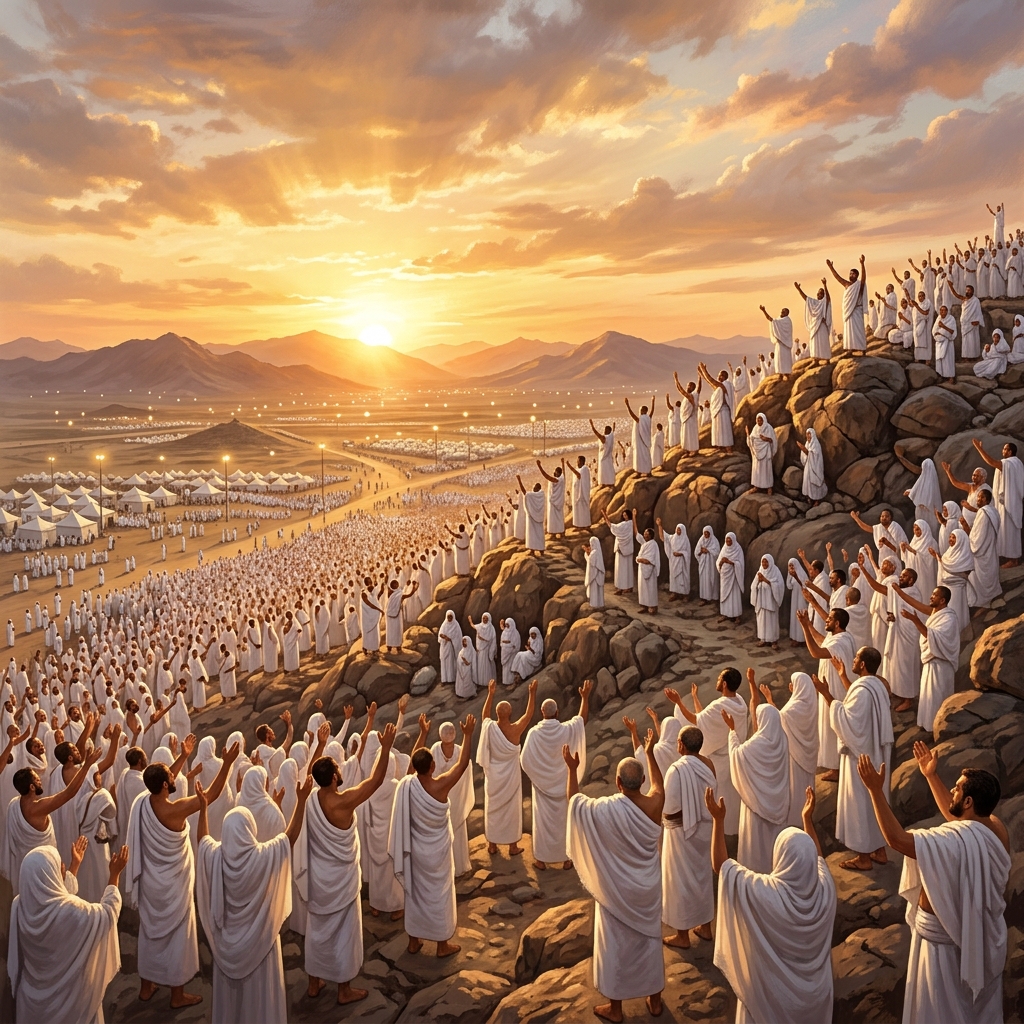
Every spiritual journey has a destination. In the pilgrimage of Hajj, that destination is Mount Arafat. The Prophet Muhammad ﷺ famously summarized the entire pilgrimage in three profound words: “Hajj is Arafah (الحج عرفة).” Without standing on the plains of Arafah on the 9th of Dhul-Hijjah, a pilgrim’s Hajj is invalid.
Yet, the profound majesty of this day is not restricted to the millions of pilgrims standing under the Arabian sun. For the global Muslim community standing in homes, mosques, and workplaces around the world, the Day of Arafah represents an unparalleled outpouring of divine mercy, forgiveness, and accepted prayer.
1. The Day the Religion Was Perfected
One of the greatest honors bestowed upon the Day of Arafah is that it was the historical moment Allah ﷻ chose to reveal the momentous verse proclaiming the perfection of Islam.
In Sahih Al-Bukhari, it is narrated that a Jewish man came to Umar ibn al-Khattab (may Allah be pleased with him) and said: “O Commander of the Faithful! There is a verse in your Book which you recite; if it had been revealed to us Jews, we would have taken that day as a festival.” Umar asked: “Which verse is that?” The man quoted:
“This day I have perfected for you your religion and completed My favor upon you and have approved for you Islam as religion.”
— (Surah Al-Ma’idah, 5:3)
Umar instantly replied: “We know perfectly well the day and the place where this verse was revealed to the Prophet ﷺ. It was Friday, while he was standing on Arafah.”
This verse sealed the divine message to humanity. It confirmed that the spiritual framework for human salvation was complete, complete in its wisdom, beauty, and justice.
2. The Expiation of Two Entire Years of Sins
For those of us not performing Hajj, Allah ﷻ has granted a breathtaking gift: the opportunity to have two entire years of minor sins wiped completely clean through a single day of fasting.
In Sahih Muslim, Abu Qatadah narrated that the Prophet ﷺ was asked about fasting on the Day of Arafah. He gave an answer that continues to fill the hearts of believers with immense hope and gratitude:
“It expiates the sins of the past year and the coming year.”
Consider the sheer generosity of this divine equation: fasting from dawn to sunset on one single day — approximately 14 to 16 hours of abstaining from food and drink — removes 730 days of spiritual blemishes. It is an offer of divine amnesty that no mindful believer can afford to overlook.
3. The Greatest Day of Freedom from Hellfire
Throughout the Islamic year, Allah ﷻ pardons sinners and frees souls from the punishment of Hell. However, there is no day in the entire cosmic calendar where this divine emancipation occurs on a greater scale than the Day of Arafah.
In a beautiful narration recorded in Sahih Muslim, the Mother of the Believers, Aisha (may Allah be pleased with her), narrated that the Prophet ﷺ said:
“There is no day on which Allah frees more people from the Fire than the Day of Arafah. He comes close and expresses His pride to the angels, saying: ‘What do these people want?'”
In another narration recorded by Ibn Hibban, Allah looks at the pilgrims disheveled and covered in dust, and says to His angels: “Look at My servants! They have come to Me disheveled and dusty, crying out from every deep valley. I call you to witness that I have forgiven them.”
4. The Supreme Supplication: The Best Dua
The Day of Arafah is primarily a day of supplication (Dua). It is the day to pour your heart out to your Creator, expressing your vulnerability, your hopes, your regrets, and your needs.
The Prophet ﷺ taught us the specific formula of praise that unlocks the gates of divine mercy on this day. Recorded in Sunan At-Tirmidhi, the Prophet ﷺ said:
“The best supplication is the supplication on the Day of Arafah, and the best of what I and the prophets before me have said is:”
“La ilaha illallah wahdahu la sharika lah, lahul-mulk wa lahul-hamd, wa huwa ʿala kulli shayin qadir.”
(There is none worthy of worship except Allah alone, without partner. To Him belongs the sovereignty and to Him belongs all praise, and He is over all things capable.)
Repeating this beautiful declaration of faith throughout the Day of Arafah affirms our absolute servitude to Allah and opens the door for all our subsequent personal Duas to be answered.
How Non-Pilgrims Should Spend the Day of Arafah
If you are experiencing Arafah from home, treat it as a personal spiritual retreat. Here is how to structure your day for ultimate success:
- Wake Up for Suhoor and Tahajjud: Rise early before Fajr. Eat a nourishing Suhoor to prepare for your fast, and pray at least two Rakʿahs of Tahajjud, begging Allah for forgiveness.
- Guard Your Senses: Fasting Arafah is not just abstaining from food. Guard your eyes from improper sights, your ears from gossip, and your tongue from arguments.
- Recite Quran with Understanding: Dedicate quiet hours of the day to reading the Quran. Reflecting on Allah’s promises softens the heart for Dua. Connecting with certified teachers at Learn Quran the Right Way can help you experience the true beauty of Quranic recitation.
- The Golden Window (Asr to Maghrib): The final hours before sunset on Arafah are the most precious. Disconnect entirely from your phone, social media, and worldly chores. Find a quiet corner, face the Qiblah, raise your hands, and make sincere Dua for yourself, your parents, your family, the oppressed, and the entire Ummah until Maghrib adhan sounds.
Experience the Power of the Quran During These Sacred Days
Learn to read, recite, and understand the Book of Allah with dedicated expert scholars.
🎓 Book Your Free Trial Class Today →
