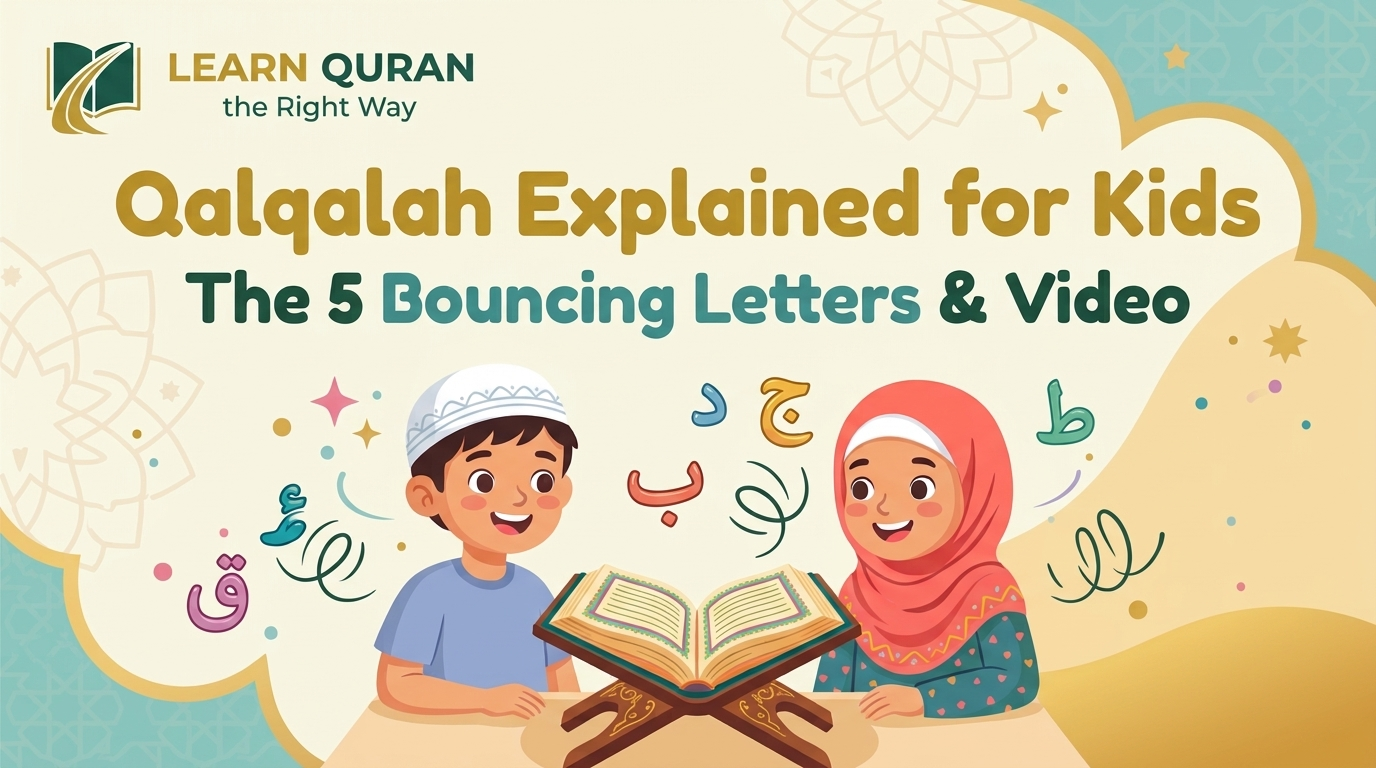
Have you heard your child read a word like الْحَاقَّةُ and wondered why the teacher wants a tiny “bounce” in it? That bounce has a name: Qalqalah. In this short lesson, Teacher Mohamed shows what Qalqalah is, which five letters make it, and how it sounds in real words from the Quran.
What is Qalqalah in Tajweed?
قَلْقَلَة (Qalqalah) is a special sound in Tajweed. Teacher Mohamed describes it in one simple line:
“Qalqalah is a little bouncing sound.”
Teacher Mohamed
We make it when we pronounce certain letters that have a sukoon ـْـ (no vowel on them). Instead of the letter stopping flat and silent, it gives a small, light echo, like a ball that bounces once.
Teacher Mohamed starts the lesson with a listening game. He reads الْحَاقَّةُ (Al-Haqqah, 69:1) slowly and asks: can you notice a little bouncing sound in this word? Listen for it on the letter ق.
The 5 Qalqalah letters: Qutbu Jad
There are five letters of Qalqalah, and they are gathered in one easy phrase: قُطْبُ جَدٍّ (Qutbu Jad).
| Letter | Name |
|---|---|
| ق | Qaf |
| ط | Taa |
| ب | Baa |
| ج | Jeem |
| د | Daal |
If your child already knows the letters from the Noorani Qaida, this phrase is a quick way to remember all five at once.
When does a letter bounce?
The rule fits in one line:
One of the 5 Qalqalah letters + a sukoon = a little bounce.
When the same letter carries a vowel (fatha, kasra or damma), it is read normally, with no bounce. The bounce only belongs to the “quiet” letter with a sukoon.
Qalqalah examples from the Quran
In the video, Teacher Mohamed reads three words. Listen to each one and find the bouncing letter:
| Word | Reading | Bouncing letter |
|---|---|---|
| سُبْحَانَهُ | Subhanahu (e.g. 2:116) | بْ Baa |
| وَالْفَجْرِ | Wal-Fajr (89:1) | جْ Jeem |
| أَحَدٌ | Ahad (112:1), when you stop on it | د Daal |
In أَحَدٌ, the Daal has a vowel in writing. But when you stop at the end of the verse, the last letter is read with a sukoon, so it bounces. That is why Teacher Mohamed reads “Ahad” twice: listen to the end of the word.
Parent tip: play Teacher Mohamed’s listening game at home. Read one of these words slowly (or replay the video) and ask your child: “Did you hear the bounce? On which letter?” Children remember a rule much better when they find it with their own ears.
Where Qalqalah fits on your child’s path
Qalqalah belongs to Stage 2: Quran Reading & Tajweed. It comes after the Noorani Qaida, once your child can read the letters and the sukoon with confidence. It sits alongside other early rules such as Ikhfa, the hidden Noon. For an overview of what to learn first, see our guide to Tajweed rules for beginners.
Quick recap
- Qalqalah is a little bouncing sound.
- The 5 letters: ق ط ب ج د, remembered as Qutbu Jad قُطْبُ جَدٍّ.
- They bounce when they have a sukoon, including when you stop on them.
- Examples: سُبْحَانَهُ · وَالْفَجْرِ · أَحَدٌ.
FAQ
What are the letters of Qalqalah?
There are five: ق ط ب ج د. They are gathered in the phrase قُطْبُ جَدٍّ (Qutbu Jad).
What does Qalqalah sound like?
A small, light bounce or echo on the letter, instead of a flat, silent stop. Teacher Mohamed calls it “a little bouncing sound”.
Does Qalqalah happen when the letter has a vowel?
No. The bounce happens when one of the five letters has a sukoon. With a fatha, kasra or damma, the letter is read normally.
Why does أَحَدٌ bounce if the Daal has a vowel?
Because when you stop at the end of the verse, the last letter is read with a sukoon. A Qalqalah letter with a sukoon bounces.
