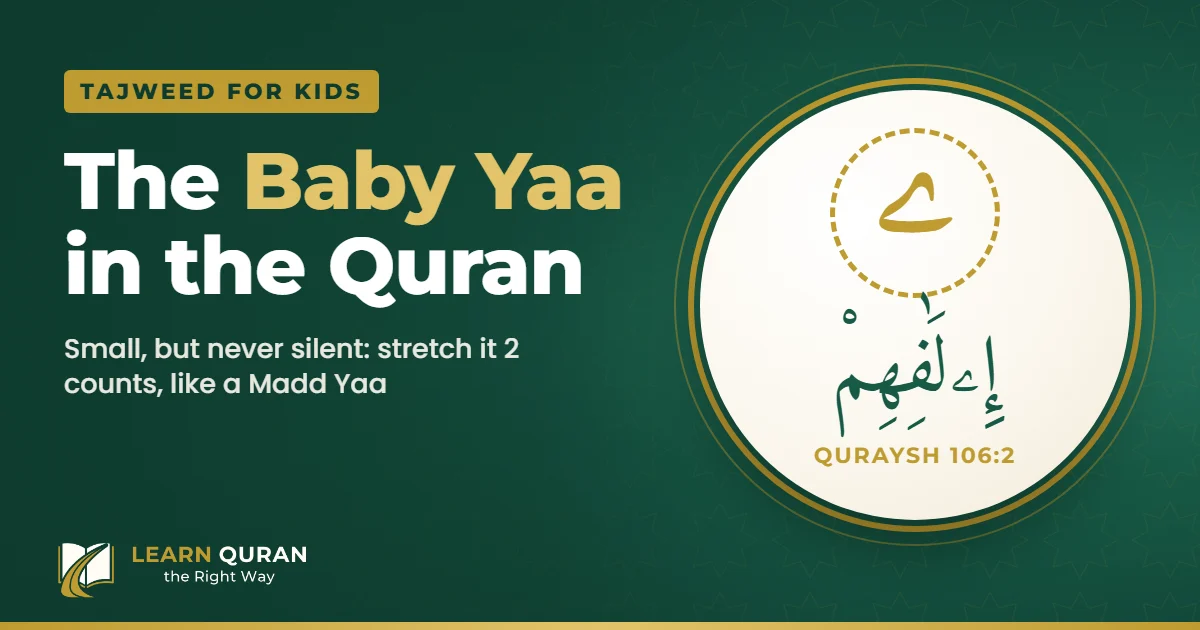
Has your child spotted a tiny letter floating next to a word in the Mushaf and asked, “What is this?” That is the small yaa in the Quran, which Teacher Farah calls the Baby Yaa. It looks small, but it is not silent: we read it just like a normal Madd Yaa. In this short video, Teacher Farah shows children how to spot it and how to read it.
What is the small yaa (Baby Yaa)?
Teacher Farah starts with a question for her students: how many letters are there in the Arabic alphabet? 28, or 29 if you count the Hamza. Then she shows them a sign that is not in the alphabet list at all:
ۦ
This is the small yaa. It is written in the Mushaf as a small sign of its own, smaller than the letters around it and not joined to them like a normal ي. Teaching it as the “Baby Yaa” helps children see that it is small, but it is still a Yaa.
“This is not a normal Yaa Madd. This is a baby Yaa, which is a small Yaa that takes the same rule as the Madd Yaa.”
Teacher Farah
How to read the Baby Yaa: same rule as Madd Yaa
Small yaa = Madd Yaa → stretch it 2 counts.
| Madd Yaa | Baby Yaa (small yaa) | |
|---|---|---|
| How it looks | ي (a full letter) | ۦ (a small sign) |
| Comes after | a letter with a kasra | a letter with a kasra |
| How we read it | stretch 2 counts | stretch 2 counts, the same |
Teacher Farah asks her students to count with her: one, two. The voice keeps going for two steady counts, no shorter and no longer, just like the long “ee” of a normal Madd Yaa.
Examples of the small yaa in the Quran
In the video, Teacher Farah reads two words. Look for the small sign ۦ in each one:
- إِۦلَٰفِهِمْ رِحْلَةَ ٱلشِّتَآءِ وَٱلصَّيْفِ (Surat Quraysh, 106:2). The Baby Yaa comes right after the first letter, so we read “ii-laafihim”, with a 2-count stretch.
- رَجْعِهِۦ لَقَادِرٌ (Surat At-Tariq, 86:8). The Baby Yaa comes after the Haa with a kasra, so we read “raj‘i-hii la-qaadir”.
Small signs like this are easy to miss, and the Dagger Alif, the “Baby Alif”, works the same way: a tiny sign that still gets its full stretch. If your child already knows the Dagger Alif, the Baby Yaa will feel familiar.
Parent tip: make it a “baby hunt”. Open the Mushaf on any page and let your child look for the tiny signs. Every time they find one, they read the word and count “one, two” out loud with the stretch.
Your child’s mission: find the Baby Yaa in Surat Al-Mulk
Teacher Farah ends the lesson with a challenge: there is one Baby Yaa in Surat Al-Mulk, from ayah 1 to ayah 15. Can your child find it? Let them search first, then open the answer.
Show the answer
Ayah 15: وَكُلُوا۟ مِن رِّزْقِهِۦ (Surat Al-Mulk, 67:15). Read it “rizqi-hii” with a 2-count stretch.
Where the small yaa fits on your child’s path
The Baby Yaa belongs to stage 2 of the path: Quran Reading & Tajweed. Before it, children learn the 28 letters of the Arabic alphabet and the three Madd letters. Alongside it come the other Tajweed rules for beginners. Reading these small signs correctly is one of the quickest ways to improve Quran recitation.
Quick recap
- The small yaa ۦ is a small sign in the Mushaf, which Teacher Farah calls the Baby Yaa.
- It is small, but it is not silent.
- It takes the same rule as Madd Yaa: stretch it 2 counts.
- Examples: إِۦلَٰفِهِمْ (106:2) and رَجْعِهِۦ (86:8).
FAQ
What is the small yaa in the Quran?
A small sign ۦ written after a letter with a kasra. It shows a Yaa sound that is read but not written as a full letter.
How many counts is the small yaa?
2 counts, the same as a normal Madd Yaa. Teacher Farah teaches children to count “one, two” with her.
Is the small yaa the same as the Dagger Alif?
No, but they are “cousins”. The Dagger Alif is a small Alif, and the small yaa is a small Yaa. Both are tiny signs that are still read with a stretch.
What if there is a wavy sign (~) on the small yaa?
Then it is a longer Madd, not the simple 2-count stretch. That is a later lesson; a teacher will show your child when they reach it.
